
This article provides a step-by-step guide as to how a Writer user can quickly and easily write a suitability report recommending an investment be put into trust.
1) Select or add the client
From the Genovo main dashboard, go to Write report and select or create the private client you wish to write the report to.
2) Select the Report Creation Method
This article walks you through the steps of building the report using Genovo’s 'from scratch' report creation method. However, other report creation methods are available which can make the report building process even quicker.
3) Create the report
In Report Details, give the report a name and select the Report Type - we'd suggest using the Suitability Report.
4) Add the required sections
Assuming you’re using the ‘from scratch’ creation method, you’ll need to add the necessary sections from the 'Available sections' drop down, which in this instance will be:
- New Investment Recommendation
- Recommended Investment Strategy
5) Complete all section wizards
Next, you'll need to step through the section wizards of all sections that require your input, as follows:
5a) The Introduction section
Progress through the steps of the Introduction section in the usual way. When you reach the Client Objectives step you should select or add the advice option(s) that accurately reflect the client's objective(s) and add comprehensive Know Your Client (KYC) information to ensure you fulfil the regulator’s expectations of you in terms of documenting a client's objectives.
If the new investment is being written into trust for Inheritance Tax mitigation reasons, there’s a Genovo advice option that already covers this:
‘Look at ways to reduce the Inheritance Tax liability that could become due on your estate on your death.’
Of course, IHT mitigation isn’t the only reason for placing an investment into trust. If there isn’t a standard advice option that meets your requirements, you can add your own Advice Option if you prefer, or you can enter the client’s objectives by typing or pasting in external content by clicking the Add objectives as freetext button.
Once you’ve selected or created your client objectives, you can click on the Edit Objective / Add KYC info link to tweak the objective wording to suit the client’s actual objectives and to add the KYC info – the ‘back story’ behind the client’s requirement to invest via a trust.
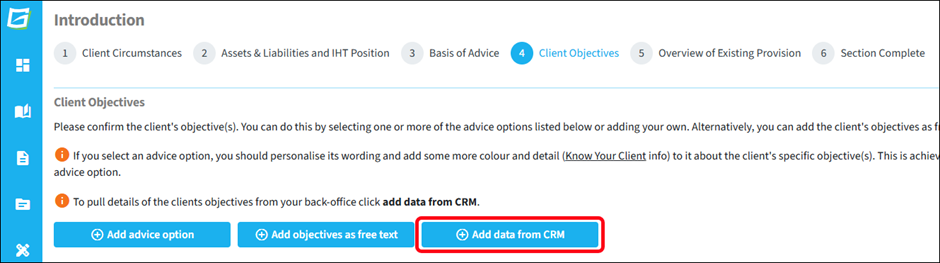
If you are integrated with intelliflo office, you can also import client objectives from IO by clicking the add data from CRM button:
5b) The Client Risk Profile section
It's in this section that you will confirm the client's attitude to risk and capacity for loss, as well as their knowledge and experience and any investment preferences.
5c) The New Investment Recommendation section
It’s worth noting that Genovo doesn’t treat trusts as ‘products’, even if they are often marketed as such (for example the Canada Life Wealth Preservation Account). Therefore, you won’t find any mention of trusts in the ‘Product Type’ field in the Plan Summary step. Instead, Genovo requires you to select the investment first (which will typically be an onshore or offshore investment bond), and then subsequently you will be prompted to select the trust that the investment is being placed into.
The recommended investment(s) can be added manually by clicking the Add plans button, or if your Genovo account is integrated with your back-office app (and you’re working with an integrated client), click the Add plans from CRM button and chose which plans you want to import.
Next, you’ll complete the two ‘why’ steps for the new plan recommendation – Why Product Type and Why Provider / Plan.
The next step is the subject matter of this blog – Trusts. If the plan is capable of being written into trust (i.e. not an ISA, etc) it will show in this step. For each plan, you can record whether it will be held under trust. There are ten trust types available.
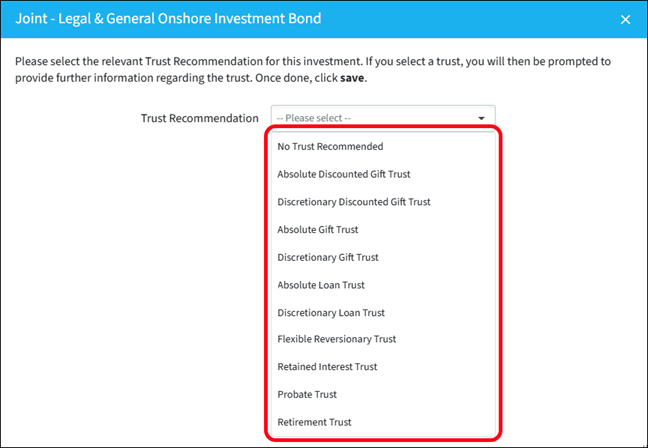
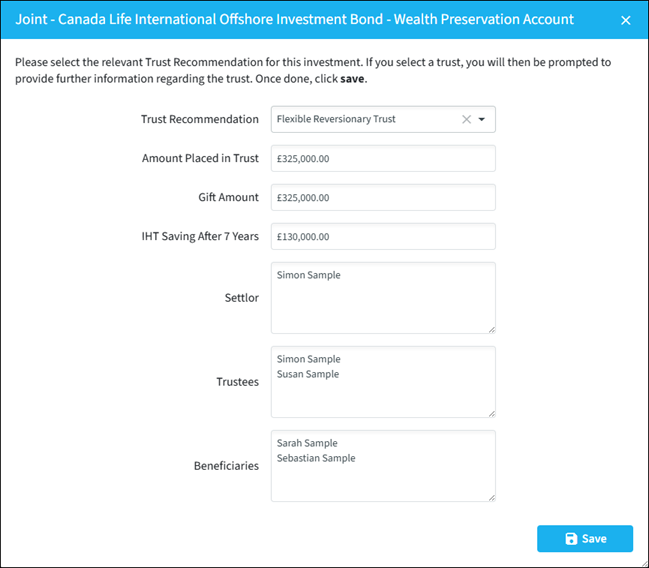
Once you’ve selected the trust type, you’ll be prompted for further key information for the selected trust type:
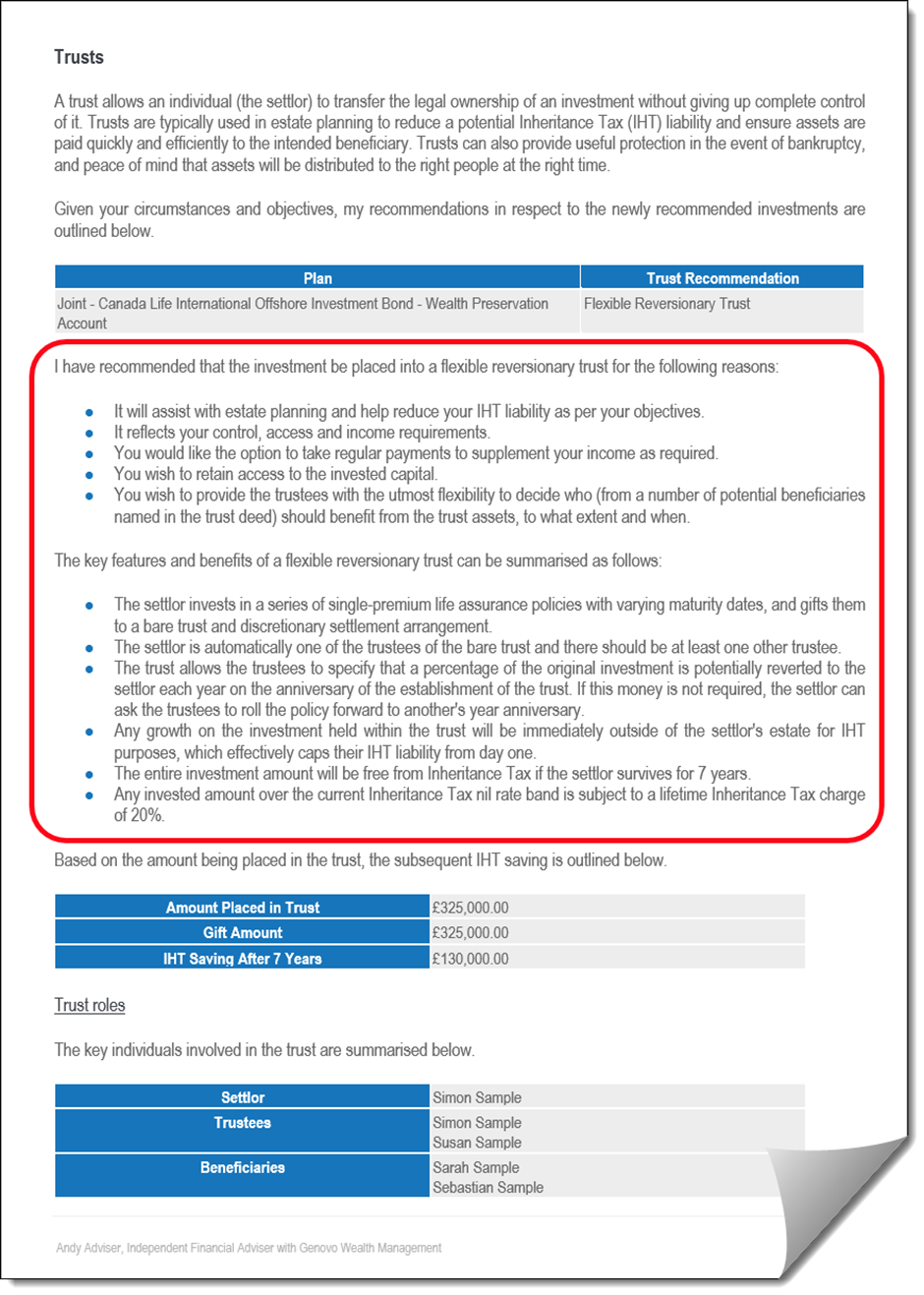
The trust type, the key information, and automated content about the chosen trust type will then appear in the completed report:
Next – complete the two remaining steps of this section:
Key Disadvantages & Tax Implications - records any disadvantages the client will experience as a consequence of the recommendation. Remember that in Genovo, disadvantages are different to risk warnings, with the former being something that will happen and the latter being something that might happen. Disadvantages are selected by the user and risk warnings are automated.
Other Solutions – this step (optionally) allows you to disclose what other solutions you considered, but subsequently discounted.
5d) The Recommended Investment Strategy section
Because you’re recommending a new plan, you’ll need to complete the Recommended Investment Strategy section to detail the investment strategy of the plan you’re recommending.
5e) The Important Information section
This is the last wizard section you'll need to complete and is self-explanatory.
6) Tailor the structure of the report
Having completed all the section wizards you should then tailor the structure of your report by unchecking any sections you do not wish to include in your report; and then change the sort order of any sections to reflect your personal preferences.
You’ll find more information about how to remove sections from your report here.
You'll find more information about how to reorder the sections in your report here.
7) Create the report
Having created the framework of the report of the report with 98%+ of the content already included as an initial draft in the Report Builder, both Writer and Reader users can then make any final tweaks to the content of the draft report in the Report Editor. To open and edit the report in the Report Editor click Create / Edit report.